Irrational Numbers
For people who don’t have energy or time today, there is TLDR at the bottom. I would appreciate it if you come back and read the full blog.
Numbers between 0 and 1
I often think about what kind of problems people would have faced before inventing things and how the inventions would have solved them. In pursuit of this knowledge, I pondered how math would have been before the invention of real numbers. What kind of gaps were they having in their models? That’s when I came to an understanding that irrational numbers are natural and part of our existence.
There are infinite numbers between 0 and 1. But there are two sets of infinities within this range,
- Numbers that you get from dividing any one integer by another integer. Eg. Splitting a pizza between 5 friends, everyone gets 20% or 0.2 pizza. We all studied how to get the fraction of any real in school like 0.42069.
- Numbers that contradict type 1 . Eg. 1.41421356…, 3.14159265358979323846…, 2.71828182845904523536… The ‘…’ simply means the number goes on without repeating itself in a pattern and we cannot get a fraction out of this. But why would we care about a number that goes on infinitely? more importantly, Can I split a pizza between 5 friends using these numbers? It cannot! But it can help you find something better. It can tell you how big of a cheese crust you will get in your pizza. How you ask!
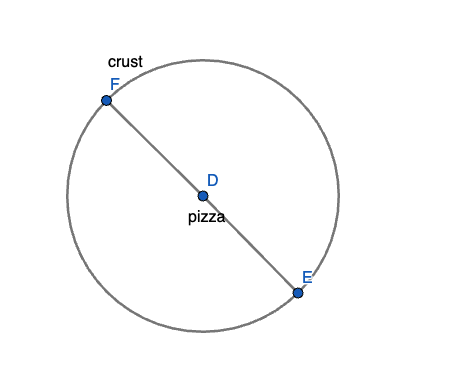
Our options for measuring the length of a circle?
- Take a thread, and carefully hold it throughout the out edge of the pizza. Mark the point where we surround the pizza.
- Take a ruler, wash it first, then measure the diameter of the pizza. Find the circumference (ie. Cheese crust length) by using 2$\pi$r.
You guessed it right, the 3.14159265358979323846… that we have seen in the example is $\pi$, an irrational number. This number is the ratio between the length that you measured with the ruler and the length that you measured with the thread. So, if you know the diameter of any pizza, you can just compute how many inches of cheese crust you will get in that pizza.
Oh wait, $\pi$ is never ending and non-repeating, how to decide when to stop
It all depends on the problem we are solving and the accuracy we need. In the last millennia, people have come up with a lot of cool ways to accurately generate this ratio. In our use cases, we can stop whenever we feel the accuracy is good enough for us. In schools, we would have only used the 3.14 approximation of $\pi$.
So the ratio of its diameter to the circumference of a circle that exists in nature is an Irrational number. Likewise, we can find irrational numbers in many real-world models.
More examples
-
Take a slide that we enjoy in parks, for argument’s sake, let’s assume the stairs and floor as two adjacent sides of a square. Then the slide will be the hypotenuse of the square. We want to know how much smooth steel we have to buy for the slide. We can use help from Pythagoras to find that $slide^2$ = $4^2$ + $4^2$, ie slide = 4*$\sqrt{2}$
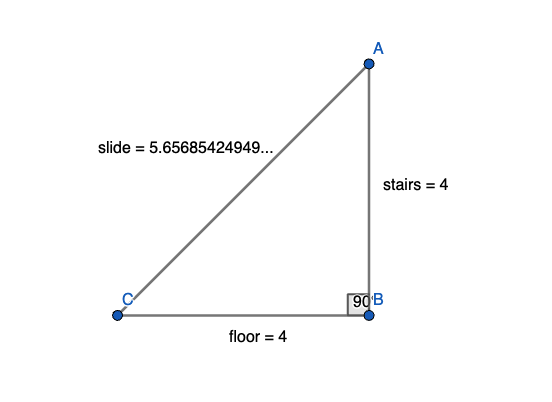
For any square with side ‘x’, the diagonal will always be ‘x’*$\sqrt{2}$.
-
In continuous exponential growth or exponential decay, the number 2.71828… also known as Euler’s number plays a vital role. It is being used in modeling population growth, compound interest, and radioactive decay.
-
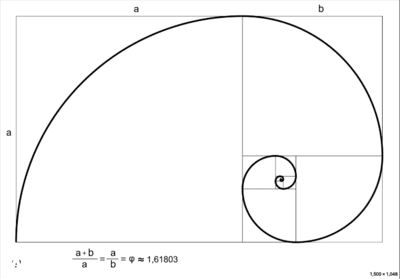
Golden ratio $\phi$ = 1.161803… . The ratio which we see in the branching of trees, spiral pattern in sea shells, arrangement of leaves, and the Human body is also an irrational number.
TLDR:
Irrational numbers are real numbers that cannot be expressed as a fraction or ratio of two integers. They are non-repeating, non-terminating decimal numbers. We might wonder what are the use cases or real-world scenarios where we might need/use them. Irrational numbers exist in nature.
- Pi (π): Pi is approximately 3.14159… and is the ratio of a circle’s circumference to its diameter.
- The Square Root of 2 (√2): The square root of 2 is approximately 1.41421… is used for calculating the diagonal length of a square.
- Euler’s Number (e) = 2.71828… used in modeling population growth, compound interest, and radioactive decay. and so much more.
This is the importance of irrational numbers. They fill in the gaps and let us model the world in a consistent, smooth and simple way.